





When it comes to reducing workers’ risk of physical injury, don’t ignore psychosocial safety. And when it comes to reducing workers’ risk of mental injury, don’t forget about physical safety.
This is the message from a study led by Dr. Peter Smith, president and senior scientist at the Institute for Work & Health (IWH). It found that poor psychosocial safety at work, and poor physical safety at work, combine to increase risk of both work-related mental health and physical injuries.
“Research has already shown how a positive psychosocial environment, where workers feel like their wellbeing is prioritized, results in lower stress and better mental health,” says Smith. “Working in physically dangerous environments is also seen as a psychosocial stressor. What we wanted to know is whether psychosocial stress, when combined with physical hazards, affects workers’ injury risk.”
The study, lead authored by Marta Pienkowski, IWH research analyst, is now published in the American Journal of Industrial Medicine (doi:10.1002/ajim.70049).
What is psychosocial safety?
Psychosocial safety refers to how much an organization is committed to ensuring the psychological and social conditions at work support workers’ mental health and wellbeing. It is demonstrated by how effectively leadership communicates and takes action to prevent workplace hazards that arise as a result of policies, job design or management practices—also called psychosocial hazards. It’s also about whether workers feel heard when they raise concerns about these risks.
While not an exhaustive list, psychosocial hazards can include:
- high or low job demands—for example, having high workloads and unreasonable deadlines, or highly monotonous or repetitive tasks that require low levels of thought processing and little variety; having breaks that are too short, too infrequent or too strictly scheduled; having shifts that are too close together and don't allow the worker to recover
- low job control—for example, not being able to schedule tasks to minimize periods of intense work demands; being micromanaged and needing permission to do routine tasks; having no say on how to do work, when to change tasks or when to take breaks
- poor support—for example, not having adequate information or tools to do the job properly or on time, lacking training for the task, lacking guidance from supervisors or other workers, not being able to ask for help when needed
- traumatic events or material—for example, witnessing or investigating a fatality, a serious injury, abuse, neglect or serious incident
- remote or isolated work—for example, working alone on night shifts, working in settings that are difficult to access in an emergency
- lack of role clarity—for example, having unclear, inconsistent or frequently changing responsibilities; having conflicting deadlines or instructions
- poor organizational change management—for example, not having information or support during organizational change, not being given training or time to learn new tasks or processes
- inadequate recognition—for example, getting unfair negative feedback, not receiving recognition for good work
- poor organizational justice—for example, being treated unfairly, being subject to favouritism or discrimination
- poor physical environment—for example, working in hazardous conditions, working with badly maintained equipment, working in settings that affect concentration on tasks
- harmful behaviours—for example, being subject to violence and aggression, bullying and harassment
How was the study done?
For the study, the researchers surveyed around 1,000 British Columbia workers about their workplace’s psychosocial safety climate using two measurement tools.
They used a validated, 12-item questionnaire called the Psychosocial Safety Climate. It asks about topics such as management commitment to address psychological health, employees’ involvement in raising and resolving psychological health concerns, and workplace communication about psychological safety issues.
Then, to measure the extent study participants might experience a physical work-related injury, the research team used the validated OHS Vulnerability Measure, which was developed at IWH. This questionnaire asks workers about their exposure to hazards (for example, working in awkward postures, carrying heavy loads, working at heights or with hazardous chemicals, etc.) as well as the extent to which three types of workplace protections are in place (see the sidebar below).
They then asked workers if they had been absent from work due to a psychological or physical work-related injury or illness in the last 12 months.
How does psychosocial safety affect injury risk?
Workers with poor psychosocial safety had more than twice the risk of a work-related physical or mental health injury compared to workers with good psychosocial safety.
How does OHS vulnerability affect injury risk?
Workers exposed to hazards without adequate protections (i.e., high vulnerability to injury as measured by the OHS Vulnerability Measure) also had an increased risk of both physical and mental health injury. Their risks of both types of injury are three times as high as workers with low OHS vulnerability.
What happens when both psychosocial safety and workers’ vulnerability to injury are examined in combination?
When the research team examined psychosocial safety and OHS vulnerability together, they found injury risks were even higher.
As would be expected, the workers with good psychosocial safety at work and low vulnerability to injury had the lowest risk of injury.
Workers with both poor psychosocial safety and high vulnerability to injury had the highest risk of injury. When compared to the group with the good psychosocial safety and low vulnerability, these workers were:
- 10 times as likely to get a psychological injury
- 4.8 times as likely to get a physical injury
If they were highly vulnerable to injury, but had good psychosocial safety, they were:
- 5.4 times as likely to get a psychological injury
- 3.3 times as likely to get a physical injury
Workers with low vulnerability to injury at work, but poor psychosocial safety were:
- 3.4 times as likely to get a psychological injury
- 1.5 times as likely to get a physical injury
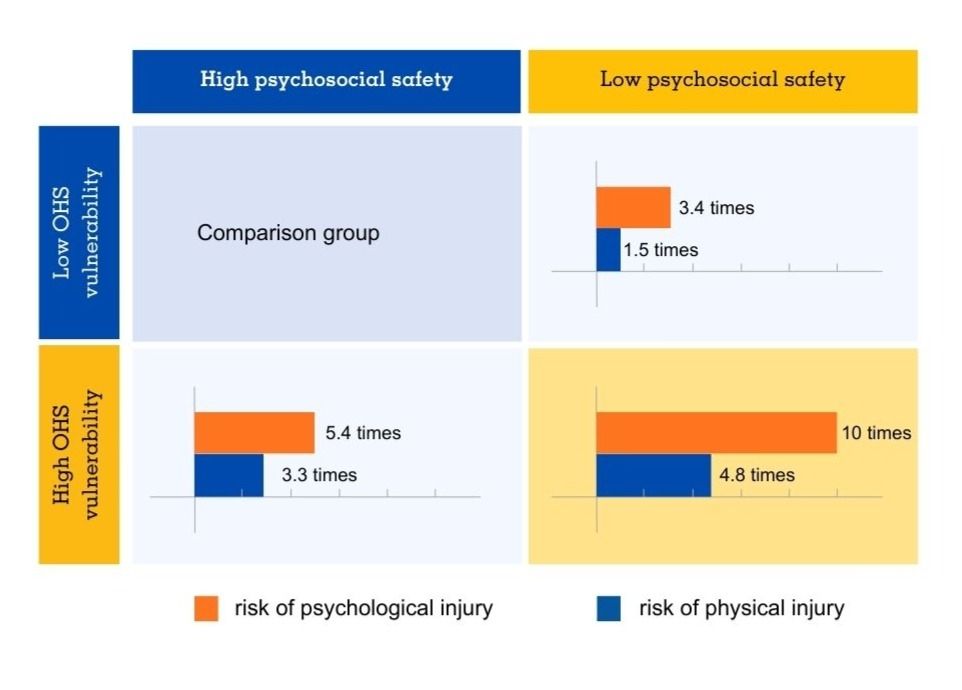
These findings show that workplace hazards and lack of protections, along with poor psychosocial safety, each add to a worker’s risk of injury.
“Preventing workplace injuries—be they physical or mental—means addressing both psychological and physical risks,” says Pienkowski. “Tackling physical safety alone isn’t enough if psychosocial safety is ignored—and vice versa.
How can employers improve psychosocial safety?
Robust OHS practices are foundational to psychosocial safety, Smith says. Employers may need to continually review their practices to make sure both mental health and physical injury risks are considered, he notes.
“Our findings emphasize the link between workers’ mental health and their risk of injury,” says Smith. “Addressing psychosocial safety and physical safety together can help to prevent both physical and mental health injuries.”
Pienkowski notes that communicating with employees about safety and mental wellbeing is an important step.
“You can have great policies, but workers need to know about them and see signs of your commitment to making the work environment safe,” says Pienkowski. “They should be aware of the risks they might face, and how to prevent injuries. It’s also important that workers feel safe telling you if they’ve noticed a safety risk.”
Smith also notes that improving psychosocial safety in a workplace starts with the top levels of an organization.
“Senior managers need to be the ones spearheading improvements,” he says. “Workers need to hear those messages from management, and see changes being made, in order to feel like their wellbeing is a priority. Addressing psychosocial risks can be daunting for workplaces, but if management commitment and worker participation and communication are in place, the job is a lot easier.”