
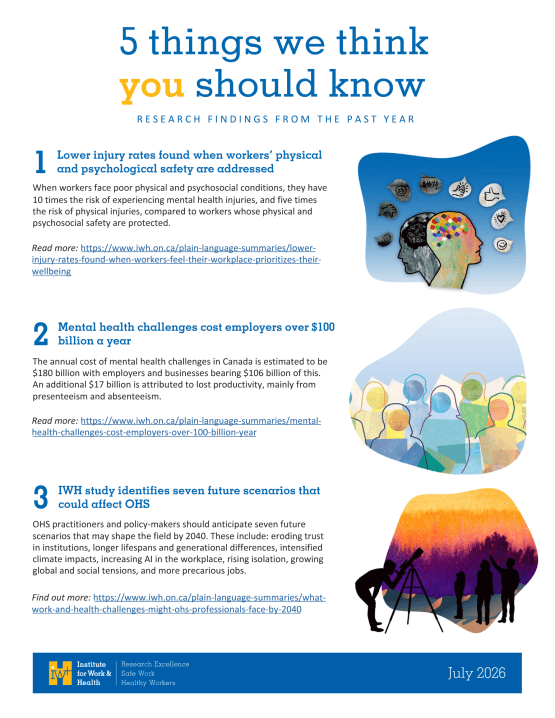






Lower injury rates found when workers’ physical and psychological safety are addressed
When workers face poor physical and psychosocial conditions, they have 10 times the risk of experiencing mental health injuries, and five times the risk of physical injuries, compared to workers whose physical and psychosocial safety are protected.

Mental health challenges cost employers over $100 billion a year
The annual cost of mental health challenges in Canada is estimated to be $180 billion with employers and businesses bearing $106 billion of this. An additional $17 billion is attributed to lost productivity, mainly from presenteeism and absenteeism.
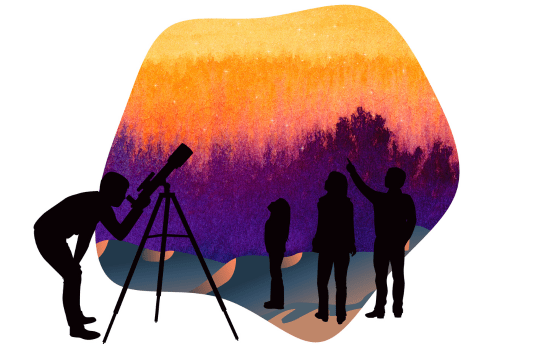
IWH study identifies seven future scenarios that could affect OHS
OHS practitioners and policy-makers should anticipate seven future scenarios that may shape the field by 2040. These include: eroding trust in institutions, longer lifespans and generational differences, intensified climate impacts, increasing AI in the workplace, rising isolation, growing global and social tensions, and more precarious jobs.
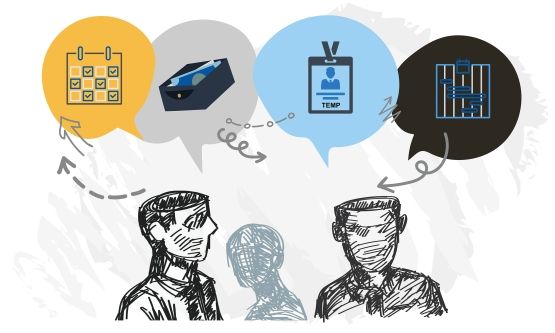
Death rates are higher for workers in precarious and lower quality jobs
Over a 13-year period, workers in precarious jobs had a 50- to 60-per-cent greater risk of dying than workers in high-quality jobs. Across a range of causes—death from unintentional injuries, heart disease and cancer—the risk of dying increases as job quality declines. The effect is strongest for death from injuries—the risk of which is double for workers in precarious jobs when compared with those in high-quality jobs.

Only a quarter of organizations are using AI for OHS
One in four organizations surveyed in Ontario and British Columbia report using artificial intelligence (AI) in their OHS activities. Use of AI is higher in larger organizations and in those with highly hazardous workplaces. OHS practitioners in workplaces using AI are more optimistic about AI’s impact on creating safer workplaces, addressing OHS costs and reducing psychological and physical injuries. But they’re also aware of the harms the technology can pose.