
Future of work
The world of work in Canada and other industrialized countries is undergoing rapid transformation. Major forces driving change include digital technologies, artificial intelligence, climate change, demographic shifts and more. This change may bring far-reaching social, political and economic consequences for a generation of workers. IWH researchers are exploring the emerging issues posed by some of these trends—on health and safety, on work inequities, and on the inclusion of marginalized groups in the future of work—and seeking policy, system and workplace actions that can be implemented now to help ensure a healthy and inclusive future for all.
Featured

At Work article
What work and health challenges might OHS professionals face by 2040?
What challenges may face occupational health and safety practitioners and policy-makers by 2040?
Published: February 10, 2026
At Work article
AI and job quality project gathers partners to develop roadmap
As artificial intelligence (AI) becomes more integrated into workplaces, a new IWH project wants to ensure that job quality—and the health and safety of workers—remains a top priority.
Published: January 14, 2026
Journal article
Journal article
Large language model exposure and precarious occupations: unpacking relationships in the Canadian labor force
Published: Scandinavian Journal of Work, Environment & Health, June 2026

IWH in the media
Research, policy and practice converge at New Horizons in Safety Summit
Ontario's safety community gathered for a full day of research, policy debate and practical insight. Dr. Arif Jetha, associate scientific director and scientist at the Institute for Work and Health (IWH), delivered some of the day's most striking numbers, writes Shane Mercer.
Published: Canadian Occupational Safety, May 2026
Journal article
Journal article
Integrating occupational health and safety into the artificial intelligence system life cycle
Published: American Journal of Industrial Medicine, May 2026
IWH in the media
New Horizons in Safety 2026 puts outcomes under the spotlight
Ontario safety leaders will gather in Markham on May 7 as the New Horizons in Safety Conference 2026 returns for its third year, with a sharpened focus on measuring real-world outcomes rather than tallying activities. The program will feature experts such as Dr. Arif Jetha of the Institute for Work & Health on AI and workplace safety, writes Shane Mercer.
Published: Canadian Occupational Safety, April 2026
Journal article
Journal article
Aligning artificial intelligence with worker health, well-being, and safety: an occupational health psychology agenda
Published: Occupational Health Science, April 2026
Infographic
Infographic
What work and health challenges may arise by 2040?
An Institute for Work & Health study used strategic foresight methods to identify future of work scenarios that may have implications for worker health, safety and wellbeing. The study found seven scenarios that can emerge by 2040.
Published: March 2026
IWH in the media
IWH in the media
Les 7 tendances à anticiper en santé au travail : 2040 c’est déjà demain
Published: Management & RSE, February 2026
Project report
Project report
Santé et travail en 2040: Anticiper les changements à venir en santé et sécurité des travailleurs
D’ici 2040, on verra des transformations rapides dans les domaines de la technologie, du climat, de l’économie, de la politique et de la société remodeler le paysage de la santé au travail. Pour les intervenants et les décideurs qui promeuvent la santé, la sécurité et le bien-être de la population active, ce paysage en évolution présentera à la fois des problèmes urgents à résoudre et des occasions déterminantes à saisir. Dans le présent rapport, on fait appel à des méthodes de prospective stratégique pour explorer plusieurs scénarios plausibles et leurs implications possibles pour les travailleurs et les milieux dans lesquels ils seront appelés à évoluer. Ce rapport a pour but de donner des clés pour anticiper les enjeux à venir, remettre en question des idées préconçues et concevoir des stratégies plus adaptatives, plus équitables et plus résilientes pour promouvoir la santé, la sécurité et le bien-être des travailleurs.
Published: February 2026

At Work article
What work and health challenges might OHS professionals face by 2040?
What challenges may face occupational health and safety (OHS) practitioners and policy-makers in the next 15 years? A strategic foresight report led by IWH recruited OHS practitioners from across Canada and Europe to help answer this question. It offers seven future scenarios that may face OHS practitioners by 2040. It also lays out important questions about each scenario that OHS practitioners may need to confront in the years to come.
Published: February 2026

At Work article
AI and job quality project gathers partners to develop roadmap
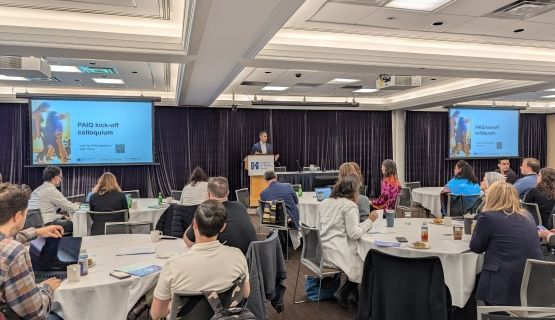
Job quality is increasingly recognized as an important factor for workers’ health, safety and wellbeing. As artificial intelligence (AI) becomes more integrated into workplaces, a new project, the Partnership on AI and Quality of work (PAIQ), wants to ensure that job quality—and the health and safety of workers—remains a top priority. The team recently came together to kick off the next seven years of work.
Published: January 2026